For property investors, a rental increase can strengthen cash flow and help an investment keep pace with the market. But the amount is only part of the equation. Timing, tenancy history and the terms of the rental agreement can determine whether that increase is available now—or months down the track.
A property can look sound on paper and still deliver less income than its purchaser expects.
Sometimes the difference comes down to a detail that receives too little attention during the buying process: when the rent was last increased.
Last week, a client purchased an investment property where the previous owner had already increased the rent. However, the revised amount was below the level our client had anticipated when assessing the purchase and its expected return.
The natural question was whether we could increase it again after settlement.
After reviewing the existing arrangements, we identified that the next increase could not take effect until August 2027, subject to the agreement terms and the required notice.
For the investor, this meant budgeting around the existing rent for longer than expected. The property’s potential rental value and its immediately available income were two different figures.
It is a useful lesson for anyone purchasing an investment—and for existing owners preparing their next rental review.
Before deciding on a new rental amount, investors should establish:
Each question matters. A market appraisal does not establish the legal increase date, and the highest proposed weekly rent does not necessarily deliver the best annual result.
A thorough review brings all three together.
For most current Victorian residential rental agreements, rent cannot increase more than once every 12 months. Some older agreements have different rules, so the tenancy’s history matters.
During a fixed term, an increase must be permitted by the agreement, which must also specify how it will be calculated. Rental providers must give at least 90 days’ notice using the prescribed form and an appropriate service method, allowing for postal delivery where relevant.
The notice must explain the calculation clearly. Generic wording such as “based on market valuation” is not sufficient by itself. Errors can invalidate an increase.
For investors, this makes accurate records essential. Ask your property manager to distinguish between the date the last notice was issued and the date the higher rent actually commenced.
Those dates serve different purposes. Confusing them can lead to incorrect assumptions about the next review.
When you purchase a property with a continuing tenancy, the existing agreement carries on and you become the rental provider. The sale itself does not reset the rent or create a fresh opportunity to increase it.
That is why rental due diligence belongs before the purchase commitment, rather than being left until the management handover.
A purchaser may see an appraisal suggesting a stronger rental return and reasonably view that as part of the property’s appeal. However, an appraisal needs context: does it describe the likely rent for a new leasing campaign, or the income available under the current tenancy?
In our client’s case, the previous owner’s increase meant the next opportunity was further away than expected. Discovering that earlier would have allowed the investor to assess the purchase using a more accurate income forecast.
Ask your solicitor or conveyancer to review the contract of sale, the tenancy particulars and any relevant special conditions. Involve your property manager alongside that legal review to assess the rental position.
The aim is to establish a complete picture, supported by documents.
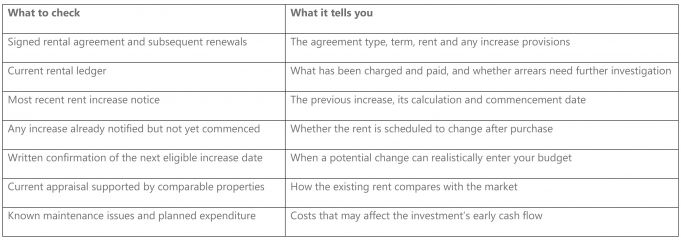
Do not assume every relevant record is attached to the contract. If something is missing, request it.
If the vendor proposes a new lease, renewal or rental change between signing and settlement, ask your conveyancer to explain the contractual position and how your interests can be addressed.
The key is to understand the arrangement you will inherit before relying on future income.
A useful investment assessment should show three distinct figures: the rent payable now, any documented forthcoming change, and the property’s estimated market rental range.
These figures may align. Where they do not, your budget should explain the gap and how long it could remain.
Consider a hypothetical property renting for $550 per week, with an appraisal suggesting $600 per week. If the higher figure cannot take effect for another 39 weeks, using it from settlement would overstate gross income by $1,950 during that period.
The calculation is straightforward:
$50 per week × 39 weeks = $1,950
That is an income difference before considering expenses. It should be visible in the purchase assessment, alongside loan repayments, owners corporation fees, insurance, rates and maintenance allowances.
An investment can still be attractive with rent below its potential. The important point is to price and budget for the position that actually exists.
A strong appraisal should explain why the recommended range suits the property.
A two-bedroom apartment is not automatically comparable with every other two-bedroom apartment in the suburb. Internal size, natural light, parking, outdoor space, heating and cooling, condition, noise and access can all influence renter demand.
Ask your property manager to explain:
An advertised price is useful evidence of competition, but it is not proof of what a renter ultimately agreed to pay.
This distinction becomes especially important when an investor is trying to justify a substantial increase using a small selection of higher-priced listings.
Higher ownership costs are a valid reason to examine an investment’s performance. They do not, on their own, establish the appropriate rental amount.
Renters can seek a Consumer Affairs Victoria assessment if they believe an increase is excessive. Current assessment factors include comparable rents, the proposed change, Melbourne CPI, increases over the preceding 24 months, the property’s condition and changes to its facilities. CPI is one consideration, rather than an automatic universal cap.
For owners, the practical lesson is to request a recommendation that can be explained and supported. Retain the comparable evidence and the reasoning behind the decision.
A clear explanation also gives your property manager a stronger basis for a constructive conversation with the renter.
A reliable renter who pays consistently, looks after the property and communicates maintenance issues promptly has commercial value.
That does not mean rent should never change. It means the decision should consider the likely annual outcome.
For illustration, an additional $20 per week produces $1,040 over 52 fully paid weeks. Two weeks of vacancy at $600 per week represents $1,200 in forgone rent, before advertising or letting costs.
This is not a prediction that an increase will cause a renter to leave. It demonstrates why the weekly figure should be assessed alongside retention, demand and potential turnover costs.
The right recommendation may still be an increase. It should follow a considered assessment of the property and tenancy.
Ask your property manager to begin reviewing the position around four months before a potential increase date. This is a planning buffer, allowing time to assess evidence, obtain instructions, prepare documents and meet notice requirements.
Waiting until the anniversary arrives can delay the additional income. A review calendar helps turn rental management into a planned process.
For the client who must wait until August 2027, the useful work now is to budget accurately, monitor market conditions, address maintenance and prepare for the next eligible review. No future rental figure should be treated as guaranteed today.
At Woodards, we encourage investors to involve their property manager before purchasing and well before a rental review falls due.
Ask for a clear assessment of what the property earns now, when that income can next change, and what evidence supports the proposed amount. Those answers give you a stronger foundation for both the purchase decision and the years of ownership that follow.


The Reserve Bank's decision to increase the cash rate by 25 basis points to 4.85 per cent is disappointing for mortgage holders, but hardly unexpected given the latest inflation figures.

A tired kitchen. Worn carpet. Walls that have seen better days. When an investment property becomes vacant, it can be tempting to renovate everything at once.

Would you hand the keys to your brand-new car to someone you barely know without making sure it was insured? It's a question we often ask investors when discussing landlord insurance.

Before a prospective renter walks through the door, much of the work that determines a successful tenancy should already be underway.

All of our agents have the experience and local knowledge to guide you

Whether selling or investing, an appraisal of value will give you the confidence to make an informed decision

Switch to Woodards Property Management